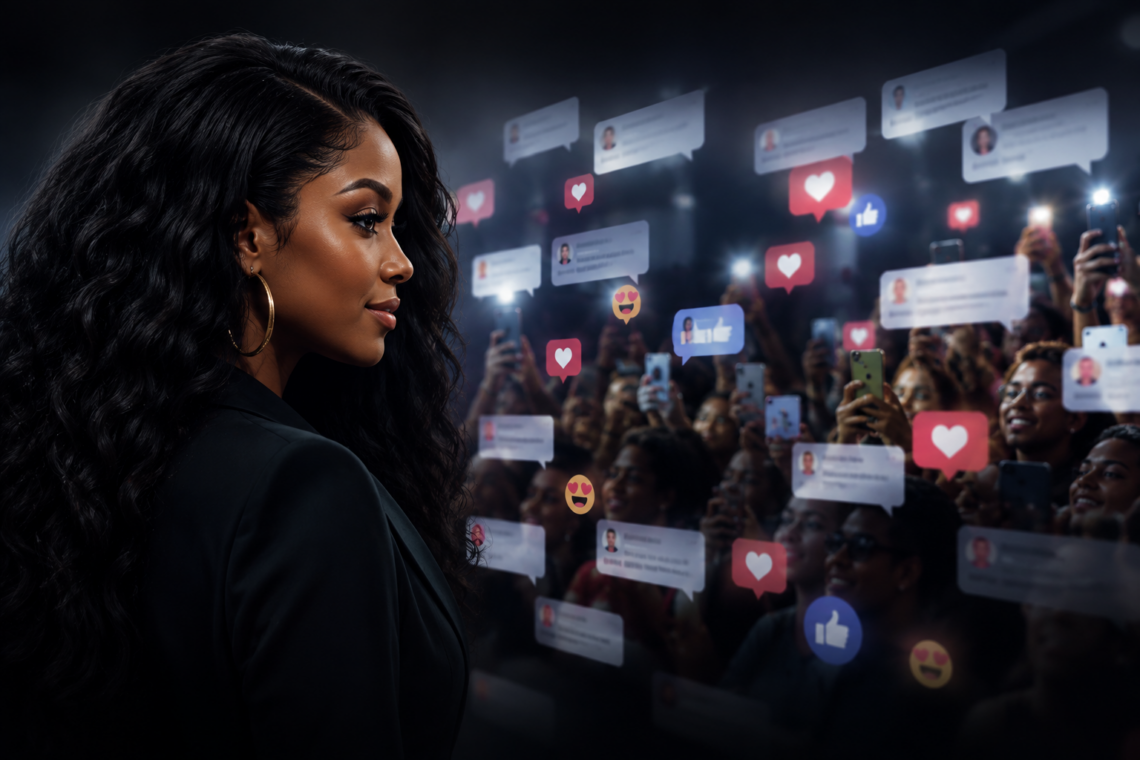
There’s something strange about social media interactions with celebrities that people don’t really talk about enough.
Not the obvious fan moments. Not the meet-and-greets, the photos, the reposts, or the excitement of being noticed by someone whose music may have shaped parts of your life.
I mean the emotional gray area that can happen when familiarity starts to blur lines.
Years ago, I had the opportunity to meet a very well-known R&B group through several meet-and-greets. One member in particular became familiar with me over time through social media. He had followed me on Twitter before eventually following me on Instagram too. At the time, it felt harmless and cool… not because I thought we were suddenly “friends,” because we weren’t, but because there was a level of recognition there, and I assumed he appreciated my support of their music catalog.
Or at least that’s what I told myself.
One day, I posted a black-and-white full-body photo of myself. Nothing inappropriate. I think I had on jeans and a white tank top. The picture itself wasn’t really the point though. It was the caption.
I wrote something vulnerable.
Something along the lines of wanting to be known for more than just my smile or my ass. I said I had a heart of gold and wanted people to understand that. Looking back, I think I was expressing a very human desire: to be seen beyond appearance.
Minutes later, that celebrity posted something about people using social media for validation and performing online.
No names were mentioned.
No tags.
But if I’m being honest, it hit me hard because in my spirit, I felt like it was about me.
And that’s where social media gets complicated.
Instead of letting it pass, I responded indirectly too. I posted something about people judging others without really knowing them and how words can hurt people. Then another post came shortly after saying something like, “If it’s not about you, why take it personal?” All of this took place on Instagram, when the app was heavily focused on images and text overlays.
At that point, the energy shifted.
It became one of those silent online exchanges where nobody is directly communicating, but everybody involved knows there’s tension underneath the surface.
I eventually posted a simple “whatever” text overlay, and years later, that’s actually the part I regret most.
Not because it was terrible.
Not because I think I embarrassed myself.
But because maturity has taught me that silence protects your peace in ways reactive posting never will.
Sometimes the strongest thing you can do is leave people unsure whether their words even reached you.
As I’ve gotten older, I’ve also learned something else: social media creates false emotional intimacy. When someone famous follows you, notices you repeatedly, or interacts with your content, your brain naturally starts assigning emotional meaning to those interactions, even if the reality is much smaller than it feels.
That doesn’t mean your feelings aren’t real.
It just means perception can become amplified online.
Looking back now, I honestly don’t know whether his post was truly about me or not. Maybe it was. Maybe it wasn’t. Maybe he was speaking generally. Maybe he was projecting his own frustrations about social media culture. Public figures see a lot every day, and sometimes they speak carelessly without realizing how personal their words can feel to somebody else.
But what I do know is this:
At the core of my original post was a woman wanting to be valued for her heart and not just her appearance.
And I think a lot more people understand that feeling than they admit.
Especially women.
Especially women online.
Especially women who are constantly being perceived before they are fully understood.
I didn’t turn this one uncomfortable interaction into “he’s terrible” or “The group’s music means nothing to me now.” A lot of people do that because disappointment makes them swing to extremes. You’re able to hold two truths at once:
I felt hurt and unsettled by that experience.
I still genuinely admire the talent and music.
And honestly, that moment taught me an important lesson about social media dynamics, especially when there’s any level of visibility, admiration, or familiarity involved. Social media collapses distance. It creates the illusion that access equals understanding. A follow, a like, a repost, or recognition can make people feel emotionally closer than they really are. Then suddenly one vague post can feel deeply personal because the boundary between public and personal got blurry.
I also learned something valuable about indirect communication online. Once people start posting “around” each other instead of to each other, things spiral fast because everyone is interpreting tone, timing, intention, and hidden meaning. And most of the time, nobody truly knows what the other person meant.
And I’ll say this too:
Wanting people to recognize your humanity beyond appearance is a deeply human thing to express. Especially as a woman. Especially online. Especially in real life.
What changed over time for me is that I’ve gained discernment. I’ve learned that not everybody deserves access to your vulnerability, and not every perceived slight deserves a response.